


What I found was mostly lake.
RB Leipzig makes the comparison easy. Red Bull founded it in 2009 by buying the playing rights of SSV Markranstädt, a fifth-tier club from a small town outside the city. By 2017 it had qualified for the Champions League without the century of memory most clubs carry.
It borrowed a global brand from a drinks company and a vacancy from a city of around half a million people that had had no Bundesliga club since 1994. The Hartono brothers, who bought Como ten years later, borrowed from a place.
In July I argued in this magazine that legitimacy in sport is inherited or slowly earned, and that LIV Golf showed how little money achieves when it tries to build it from nothing.
Como fits that argument better than it first appears.
The Hartonos, the Indonesian billionaires behind the Djarum group, paid about 200,000 euros for the club in April 2019, according to Calcio e Finanza's reading of the official documents. Como was in Serie D and had gone bankrupt in 2004 and again in 2016. What the brothers bought was a dormant inheritance, a name from 1907 and a Serie A past. What they attached it to was a place the rest of the world already wanted to visit.
I would add a third source to the July list: legitimacy can be borrowed from a place. The loan covers an audience and a price point. Who pays for the team is a separate question, and at Como the answer is the owners.


The Brand That Has a Team
Como came back to Serie A in 2024 after twenty-one years away. That year, according to Lombardy's regional statistics, overnight stays in the provinces of Como and Lecco passed six million, up from five and a half million in 2023. About 85 percent of the guests in Como province came from abroad.
Mirwan Suwarso, Como's president, has been unusually open about what that means for the club. In SportsPro's account of an interview in August 2025, Lake Como is the master brand and the owners see Como as a brand that happens to have a football team.
"We don't have sporting ambition, we have business ambition," Suwarso said. He named a target of a group worth a billion dollars by 2038.
His figures for the lake run larger than the region's. He told SportsPro that visitors reached 4.8 million in 2024 against 1.6 million before Covid, a tripling. Lombardy's series had overnight stays in Como and Lecco about a fifth above 2019 in 2023. The two series count different things, and a tripling against a fifth is still a wide gap.
The commercial side is built for the visitor. By Suwarso's count about 40 percent of ticket revenue comes from international visitors. The club runs four shops of its own, with around 480 affiliate stores across the province.
Rhuigi Villaseñor, the Los Angeles designer who founded Rhude, became chief brand officer in October 2024, and Brioni tailors the squad's matchday suits.
Spear's put numbers on it in August 2026: a private dinner on a Riva speedboat for 1,740 euros, a seaplane-and-boat package for 980, and a quilted leather bomber from Curva for 1,500. Curva, a label and shop that nss sports describes as a side project of Como, shares its name with the Italian word for the stadium end where the loudest supporters stand.
Take a visitor who has never watched a Serie A match. They spend three days on the lake, pass a club shop on the way to the ferry, and buy the blue shirt because it looks like the trip. They put it on before the boat leaves.
The league table never came into it.

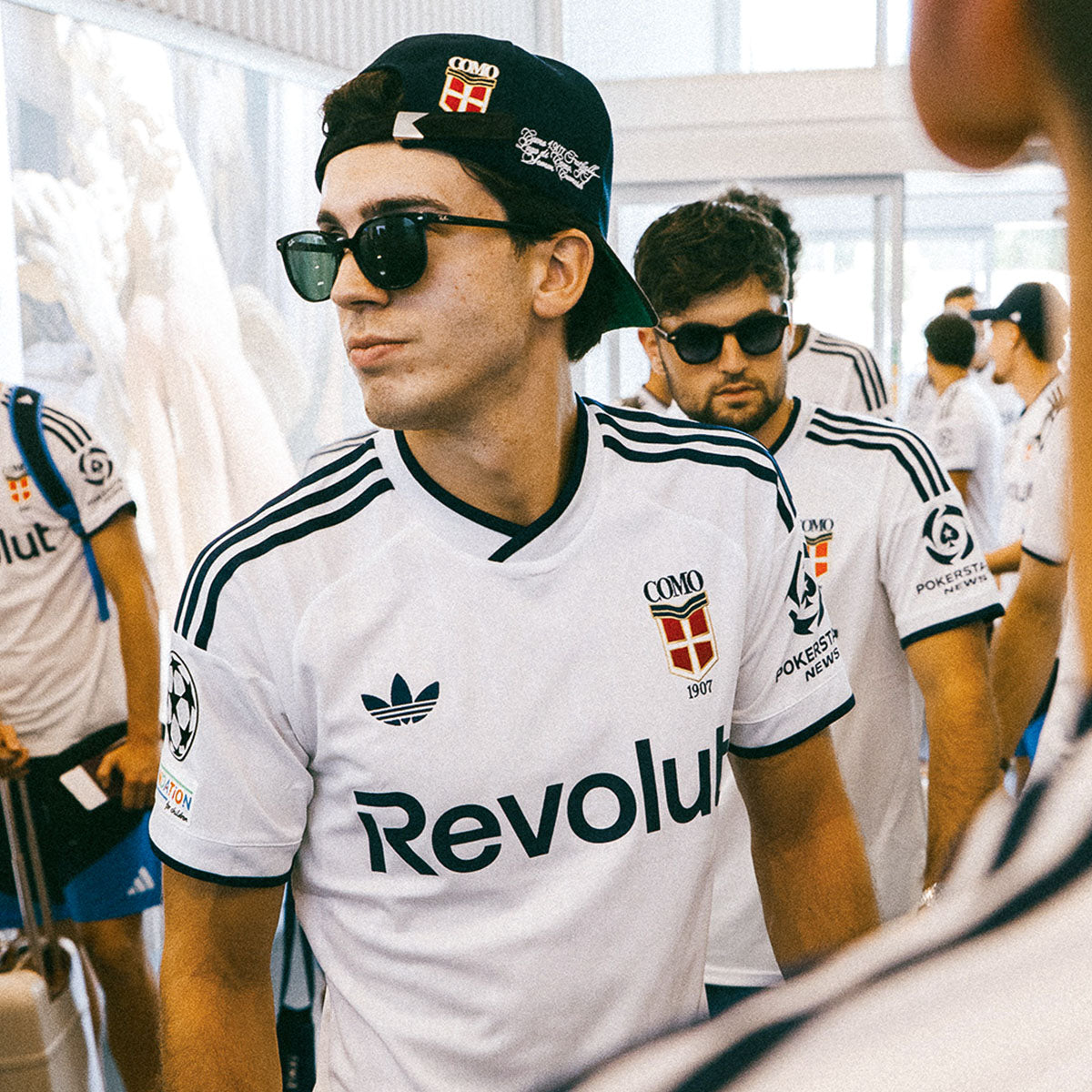
Suwarso says merchandising revenue went from about 53,000 euros when he arrived to more than ten million. He does not say which seasons he means, so I would treat the figure with care.
The Como Companion, a local site that follows the club, put merchandising at about 1.35 million euros by mid-2024. That would make the ten million a sevenfold jump in a single season, and I found no independent confirmation of either number.
That season was Como's first in Serie A, so growth on that scale is plausible. Whatever the exact figure, a shop that barely existed in 2019 now sells the town to people who came for the lake.
What the Lake Does Not Pay For
The filings read differently from the interviews. In 2024/25, its first season back in Serie A, Como 1907 S.r.l. lost 105 million euros, the largest loss in the league, according to Calcio e Finanza. Operating revenue before player sales came to about 48 million euros, and wages alone to about 86 million.
A consolidated statement the club prepared for UEFA licensing, quoted in a press review on the Italian site Roma24, puts the wider group's loss at 132 million. That would suggest the businesses around the club lost money as well. I have not found the original of that statement, so I hold the number loosely.
The Hartonos have covered the gap.
Calcio e Finanza, which tracks the club's filings, counts about 297 million euros of owner money since 2019. The total includes the purchase price and 7.4 million euros of related-party revenue, and 69 million of it arrived in the first five months of the 2025/26 season. It is roughly fifteen hundred times the purchase price.
Here is the strongest objection to everything above. Capital paid for the Champions League place. It paid for Cesc Fàbregas as head coach and for a squad that finished fourth in Serie A in May. By the count of the Italian site Zeta Vision it paid about 133 million euros in transfer fees in 2025/26 alone, which sits oddly beside a president who says the club has no sporting ambition.
I read the squad as advertising spend. Every home match puts the lakeshore on television, and the Hartonos pay for that airtime in wages and transfer fees.
What the capital leaves unexplained is the shape the business took: a label, a hospitality offer, a members' club in a lakeside villa opening in October 2026, and a services company that sells the model to other clubs.
The money paid for the football. I read the lake as what gave the money its commercial form, in luxury prices, foreign buyers and a hospitality menu that a club in an ordinary provincial town could not put on sale.
The same club reads as two different stories depending on the language. SportsPro, Spear's and investor newsletters on Substack write Como up as the future of the club as a lifestyle brand. Calcio e Finanza, Lettera43 and Il Messaggero work from the club's filings and treat it as a warning.
One Lettera43 analysis ran under the headline "perché il Como non può essere un modello", why Como cannot be a model. The English version reads the shop, the Italian version reads the balance sheet, and anyone pricing Como as an asset needs both.
The Lagoon Next Door
Venezia FC ran a fashion version of the same idea. From 2020 until May 2026 the club was led by Duncan Niederauer, a former chief executive of the New York Stock Exchange, who has since handed the presidency to Francesca Bodie and kept a minority stake.
Under his group the team wore fashion-led kits, first Kappa and the design studio Bureau Borsche, then Nocta, the line Drake runs with Nike. Drake himself is among the co-owners.
The Owners Club, an investor newsletter on Substack, put the thesis in May: "Venice, the city, is the asset. The football team is the vehicle." That is Suwarso's lake argument moved to a lagoon.


Over five seasons under Niederauer's group the club lost 147 million euros in total, according to Calcio e Finanza. That is about half of what the Hartonos put into Como in six and a half years.
In May the club said it had completed a fundraise of around 100 million euros.
The season that puts the two clubs side by side is 2024/25, because both were newly promoted. Venezia reported revenue of about 52 million euros and a loss of 36.5 million. Como reported about 48 million in operating revenue before player sales and a loss of 105 million.
The two revenue figures may not be built the same way, but the pattern is plain. The revenue lines sit close together and the loss lines do not. Como lost almost three times as much and finished tenth. Venezia went back down.
I cannot separate from the filings how much of either club's revenue came from its place and how much from playing in Serie A. I read the gap as capital: the Hartonos funded a loss almost three times Venezia's, and it bought a team that finished tenth.
One detail may link the two clubs directly, and I have found nothing from either club that confirms it. On 28 April 2026 Venezia announced a multi-year agreement with a company called Curva, which it described as an international specialist in merchandising and product development and credited with helping to deliver its 2025/26 kits and collections.
Como's Curva already sells the merchandise of AC Milan, AS Roma and Bologna. If the two are the same business, the club that sells the lake is dressing the club that sells the lagoon.
Who Keeps What the Place Earns
Como describes Sent Retail as the fashion and lifestyle affiliate created by the group behind the club. It sells retail and merchandising services to other sports organizations under what Como calls a multi-club servicing model.
In April 2026 it launched R4F, short for Rhude 4 Fans, a line of capsule collections for Tottenham Hotspur, Everton, LAFC, Al-Ittihad, AlUla, Pisa and Como itself. According to SportsPro, the club also offers its ticketing platform to other teams as a white-label product.
Footy Headlines, citing Sports Business Journal, reports that from 2027/28 Como will drop Adidas and make its own kits inside the same servicing model. The same report says the Adidas deal paid the club in kit and no fee, so leaving it costs no income.
Tottenham is on that list. Within days of Como's win over Leipzig, the London club launched Hotspur Labs with The Players Fund, a platform for venture-backed companies from Series A upward.
It offers them a route into Tottenham's audience, technology and commercial operations, and Tottenham says it wants to "share in some of that growth". The announcement names no companies and gives no budget or equity terms.
The Players Fund had built a similar platform at Como a year earlier, called Como Ventures. So a Premier League club is borrowing a venture structure that its partner first built at a lakeside club, and it sits on that club's R4F list as well.
How much of this can count toward the team depends on one label in UEFA's rules.
The squad cost rule measures player spending against adjusted revenue. That revenue includes income from non-football activities related to the club, less the costs of running them. Income from non-football activities not related to the club is left out, and so is any income from a connected party above fair value.
UEFA's club licensing regulations also pull a group company into the club's reporting perimeter when it handles football activities such as merchandising, ticketing and sponsorship. A company can stay outside only in narrow cases, such as a business with nothing to do with football or the club's brand.
Read together, they make the label the contest. A hospitality offer sold under the club's name looks like the first kind. On the other side sits the members' club, of which Suwarso told Spear's that "it has nothing to do with the football club". If UEFA accepts that description, its income cannot count toward squad spending.
Where Sent Retail falls I could not find in anything published. Whether the owners drew those lines with UEFA in mind or for ordinary commercial reasons, I cannot tell from the outside. UEFA will assess Como's 2026 accounts, the first it has examined, and I expect that is where the lines get tested.
I do not know whether the businesses around Como will ever make money. Nothing published so far shows that they do, and the one consolidated figure reported for 2024/25 points the other way.
What I can see is where the upside would land if they succeed: with the owners' group and affiliates like Sent Retail, and in the club's own numbers only as far as that label allows.
What I Admire and What Stays
I like what I see anyway.
Companies and clubs that keep looking for new things to offer their customers earn my respect. Como does it constantly: a shirt, a dinner on the water, a members' club, a kit line for other clubs, a ticketing platform.
In my commercial work I call the opposite the One Offer Trap, a company that depends on a single offer. Whether each of Como's offers turns into a business, I do not know. The habit of trying them is what I admire.
A second thing may matter more, and the filings cannot show it. A town that waited twenty-one years for Serie A now hosts a Champions League night.
Como seems to be giving the people who live around the lake, and the fans who follow the club from far away, a new kind of identity and a reason to belong. Nothing I have read measures that, so it is an impression, and I hold it as one. I find it wonderful.
If Como is ever sold, the buyer gets a name from 1907, a squad and a wage bill that ran to 86 million euros in the first Serie A season. The label, the hospitality business and the servicing company can stay with the family that built them.
The lake will stay where it is, and it was never part of the deal.