

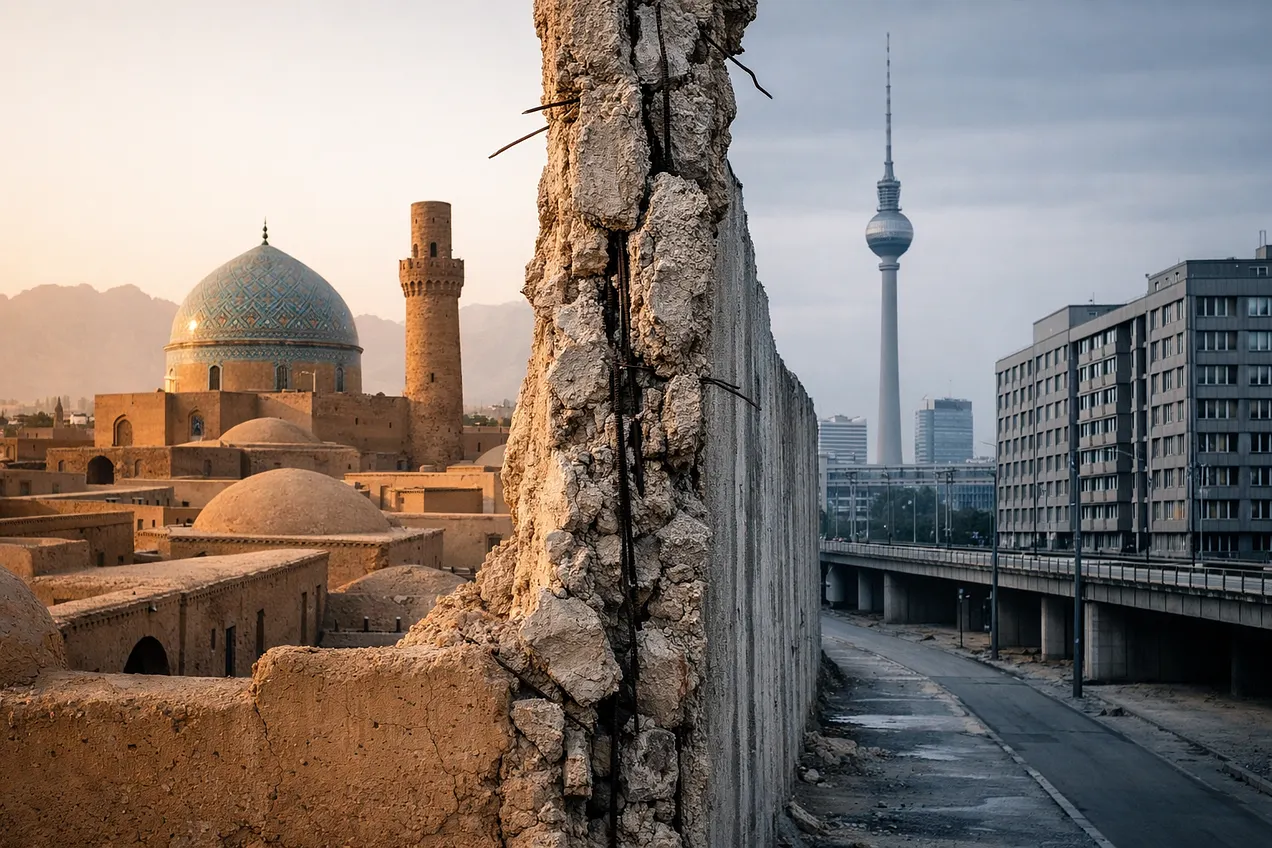
What I’ve learned watching regimes collapse, both as a child who lived through one and as an adult who operates across borders where others are unfolding now, is this: countries have to apply to their citizens. Not once. Continuously. The moment they stop, the contract begins to dissolve. Sometimes slowly. Sometimes overnight.
What changes is whether anyone gets shot in the process.
Before I continue, I have to emphasize on how brave the people in Eastern Germany were who went to the streets in 1989. How brave the first few hundred were who met at the Nikolai church in Leipzig. Who were infiltrated by the secret police (Stasi). Who still assembled even though they knew, imprisonment and torture were waiting.
And how brave any people are who take it to the streets against a regime that opprosses them!
The Disney Version We Tell Ourselves
We like to tell the story of 1989 as a triumph. Peaceful revolution. Candles in Leipzig. Courage defeating tyranny. The people rose up, and freedom won.
It’s a good story. It has merchandising potential. It plays well at anniversary ceremonies with dignitaries and speeches about democracy.
It’s also not exactly what happened. It’s not wrong. But it’s not the whole story.
The German Democratic Republic didn’t fall because freedom always wins. It fell because the regime was bankrupt, because Moscow had lost interest in propping up failing satellites, and because a mid-level party functionary named Günter Schabowski fumbled his way through a press conference on the evening of November 9, 1989.
A reporter asked when new travel regulations would take effect. Schabowski, who had been handed a note minutes before without proper briefing, shuffled through his papers and said: “sofort, unverzüglich.” Immediately, without delay.
He was supposed to say tomorrow morning. After people obtained passports. Through proper channels.
Instead, within hours, tens of thousands of East Berliners showed up at the wall. The border guards had no orders. No one wanted to take responsibility for opening fire. By 11:30 p.m., the gates opened.
Not because of a master plan. Because of a bureaucratic accident at exactly the moment when the system was too weak to respond with force.
We had luck. Unfathomable luck.

Machine Guns That Never Fired
In Leipzig, where the Monday demonstrations started, there’s a balcony on the ring road around the city center. On October 9, 1989, machine guns were positioned there. The Stasi headquarters sat across the street. Seventy thousand people marched that evening, carrying candles, chanting “Wir sind das Volk.” We are the people.
Eight thousand security forces were deployed. They had permission to use force.
They didn’t.
Not because they suddenly discovered compassion. Because 70,000 was too many. Because the math didn’t work. Because someone, somewhere in the chain of command, decided that the cost of maintaining the regime that night exceeded its remaining value.
I was eight years old. I didn’t understand what was happening. What I remember is the electricity in the air, the sense that something had shifted. Adults spoke differently. My parents watched West German television, which we’d always watched but now with different urgency.
Within a year, everything I’d known was gone. The system collapsed so fast that even the people who’d opposed it didn’t quite believe it.

What Collapse Actually Looked Like
My adolescence was spent watching East Germany be dismantled.
The Treuhandanstalt, a privatization agency founded in the GDR in 1990 and later largely led by West Germans, took over 8,000 state-owned companies employing four million people. Within four years, one-third of those companies were liquidated. Industrial production fell by half. Unemployment, which had been nearly zero under socialism’s guaranteed employment fiction, reached around 1.27 million in eastern Germany in 1994.
Entire cities lost their economic foundations overnight. The combines that had employed thousands shut down because West German firms didn’t need the excess capacity. Factory towns became ghost towns. My parents’ friends disappeared into early retirement schemes or retraining programs that led nowhere.
What the celebratory narratives skip is the part where freedom arrived with mass unemployment, where reunification felt less like liberation and more like hostile acquisition. Eighty percent of privatized firms went to West Germans or foreigners. The people who’d lived under communism found their professional qualifications suddenly worthless, their life experience dismissed as irrelevant.
The structural differences between East and West Germany persist thirty-five years later. Higher unemployment. Lower wages. Different voting patterns. Political alienation that feeds radical parties on both left and right. The Treuhand experience is still invoked as trauma, as the moment when East Germans learned that transition to democracy could feel like punishment.
I don’t tell this to diminish 1989. I tell it because the mythologized version obscures what actually happened and what it cost.
The Ones Who Weren’t Lucky
When I look at Iran right now, I see a different outcome from the same conditions.
The protests started in late December 2025 with merchants in Tehran’s Grand Bazaar shutting their shops. Economic collapse. The rial lost half its value in a year. Food prices up 72 percent. An inflation rate of 42 percent. The same structural bankruptcy that killed the GDR.


.jpg)
But where East Germany had Moscow’s disinterest and internal regime paralysis, Iran has a security apparatus willing to kill in industrial quantities.
As of mid-January 2026, estimates range from hundreds to potentially thousands dead. The exact number is unknowable because Iran shut down the internet and international phone access. What’s clear is that when 70,000 East Germans faced 8,000 security forces in Leipzig, no one fired. When similar numbers showed up in Iranian cities, the shooting started.
The difference isn’t courage. The protesters in Tehran are as brave as the ones in Leipzig were. The difference is whether the state still believes it can maintain itself through violence, and whether external constraints prevent it from trying.
East Germany in 1989 knew it was over. The regime was broke. Soviet support was gone. Honecker had been removed. Krenz was scrambling for any option that didn’t involve bloodshed because bloodshed would trigger Western response and accelerate the collapse.
Iran’s regime believes it can survive if it kills enough people fast enough. It may be right. It may be wrong. But that belief is what changes the equation.
The Venezuela Variable
Venezuela sits between these outcomes.
July 2024: Nicolás Maduro claims reelection despite opposition evidence showing he lost decisively. Protests erupt. At least 24 people killed, over 2,200 arrested by August. “Operation Tun Tun” sees authorities going door-to-door arresting protesters. Pro-government militias called colectivos commit most of the killings.
The regime cracks down hard but not hard enough to stop the movement entirely. Unlike Iran, where internet blackouts are comprehensive, Venezuela’s repression is inconsistent. Unlike East Germany, where external pressure made violence untenable, Venezuela’s government calculates it can get away with selective brutality.
Then on January 3, 2026, U.S. forces intervene and capture Maduro. His vice president, Delcy Rodríguez, takes over as acting president; the governing apparatus remains in place.
I’m not here to judge whether that intervention was legitimate. What interests me is what it reveals about the collapse mechanism. Venezuela’s leader wasn’t removed by internal pressure alone. External force removed Maduro, but that did not itself dismantle the regime or establish a democratic transition.
It’s a different pathway than either East Germany or Iran. Not pure internal collapse. Not pure repression succeeding. Something in between where outside intervention removes the leader while leaving the direction of the political transition unresolved.
The Application Process Never Ends
What I’ve come to understand operating between Dubai, Europe, and Asia is that countries are constantly applying to their citizens. Not through formal processes but through daily performance.
Can I earn a living here? Can my children get educated? Can I access healthcare? Is the currency stable? Do the rules apply predictably? Does the state take more than it provides?
These aren’t abstract questions. They’re the basis of the social contract. When enough people answer no to enough of these questions, the contract dissolves. What happens next depends on whether the state can maintain itself through force, whether external actors intervene, and whether there’s a moment like Schabowski’s press conference where systemic weakness and public pressure intersect.
East Germans in 1989 answered no to most of those questions. So did Iranians in 2025. So did Venezuelans in 2024. The difference in outcomes isn’t about which population wanted change more. It’s about the specific mechanics of how regimes maintain or lose their monopoly on violence, and whether the international environment constrains their options.
When Mobility Becomes Response
For people like me, globally mobile operators who’ve built businesses across borders and lived in eight different cities over fifteen years, there’s a different calculation.
When a country stops applying successfully, I don’t wait around to see if it collapses or if the collapse is peaceful or if external intervention tips the balance. I leave.
I understand my privilege. Most people can’t just relocate to Dubai or Singapore or Berlin when their government becomes illegitimate. They’re stuck with the citizenship lottery they were born into.
But what globally mobile operators learn is that the application process is visible if you’re watching for it. Tax policy as extortion rather than exchange. Regulatory capture disguised as consumer protection. Infrastructure that extracts value without creating it. Capital controls that trap wealth rather than grow it.
Germany as a whole stopped applying to me effectively around 2010, and even more so 2018. Not because of one policy but because the cumulative burden of operating there exceeded the value it provided. Tax structure designed to punish entrepreneurship. Regulatory complexity that favored large firms over small. A culture that treated business building with suspicion rather than support.
I didn’t stay to see if it would reform. I structured my life around jurisdictions that wanted what I do.
That’s the mobility response. It’s not available to factory workers in Leipzig or shop owners in Tehran. But it’s increasingly how capital and talent make decisions. Countries that forget they’re in competition for both lose both.
The Pattern That Holds
What I learned living through one regime collapse and watching others unfold is this:
Regimes don’t fall because people suddenly decide they want freedom. They fall when the state can no longer perform the basic functions that justify its existence, and when the cost of maintaining control through force exceeds the regime’s remaining resources or will.
Sometimes that happens peacefully because external constraints or internal paralysis prevent violence. Sometimes it happens through bloodshed because the security apparatus still believes in its own survival. Sometimes it requires external intervention to tip already-unstable dynamics.
But the underlying mechanism is the same. The state stops applying successfully to its citizens. The contract dissolves. What happens next is contingent on violence capacity, international environment, and accident.
East Germany got lucky with timing and geopolitics. Iran is getting unlucky with both. Venezuela got something in between: external force removed Maduro, while the regime’s future remained unresolved.
None of these were inevitable. All of them were predictable once you understood that countries have to continuously earn the consent they claim to possess.
What Gets Lost in Translation
There’s something else that gets missed in the triumphalist narratives.
Regime collapse, even peaceful ones, are traumatic. The system I grew up in was oppressive and economically bankrupt. It deserved to fall. But watching everything you knew get dismantled, watching your parents’ professional identities become worthless, watching your town’s factory close and never reopen, that’s not the Disney version of liberation.
People in Iran right now aren’t just fighting for freedom. They’re fighting with the knowledge that what comes after might be worse, or might take decades to stabilize, or might leave them economically destroyed even if it’s politically better.
The Iranians killed by their government won’t benefit from whatever system eventually replaces this one. The East Germans who spent the 1990s unemployed didn’t get to enjoy the prosperity that eventually came to parts of reunified Germany. The Venezuelans whose businesses were destroyed during the crisis won’t necessarily recover even if Maduro’s replacement improves governance.
Collapse has winners and losers. Usually more losers than the storytelling acknowledges.
The Question That Remains
I don’t know if the pattern holds everywhere. Iran’s protests might succeed or they might get crushed. Venezuela post-Maduro might stabilize or might descend into further chaos. Other countries where the state is failing its citizens might collapse or might muddle through for decades.
What I do know is that treating 1989 as proof that people power always wins obscures the actual mechanics. East Germany fell because of specific conditions that aligned in specific ways. Machine guns were positioned but never fired. Schabowski stumbled through a press conference. Moscow had checked out. The regime was too weak and too broke to fight.
Change that any one of those variables and the outcome changes.
The people in Iran are as brave as the people in Leipzig were. They’re just operating under different constraints with different resources against a different type of state.
That’s not pessimism. That’s recognition that geography, timing, and geopolitics matter as much as courage. Maybe more.
For those of us watching from outside, the lesson isn’t that freedom always wins. The lesson is that states exist on borrowed consent, and when they stop applying successfully to their citizens, the contract begins to fail. How it fails, whether anyone dies in the process, and what replaces it depends on variables well beyond individual courage.
That’s the pattern I’ve seen hold. Not the Disney version. The one where luck, timing, and structural conditions determine whether machine guns fire or whether border guards just open the gates and let people through.
And to the people in Iran, I really deeply hope this works out for you!